

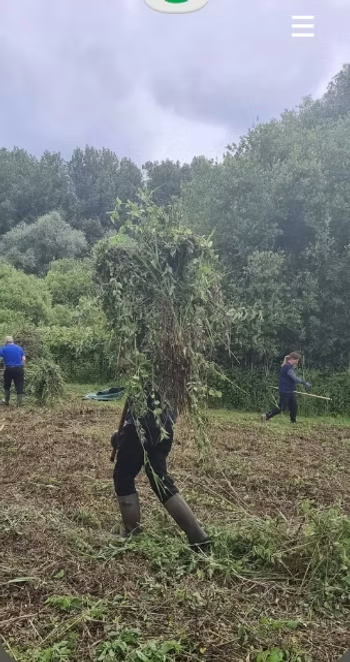
We are looking for volunteers to help us clear the meadows after they have been flailed. September blog
The last time we cleared the Fen Meadow it took 90 minutes for 18 of us to clear the meadow. This time we would like to do the wildflower meadows as well. Do you have racks, pitchforks and gloves? Could you come and help us, please? If so do contact us.
This has been a particularly good year for hops but we won't be setting up a brewery yet! Maybe it has been the warmer temperatures and the lack of rain.
It is a pleasure to see how well everything has survived the heat and the no rain.
The Guelder rose is always vibrant no matter the season. Industrious, delicate, colourful, the spindle tree is at its loveliest in autumn when its leaves turn russet and its pink and orange fruits ripen. Wildlife loves its leaves and fruit, and aphids flock to it, bringing with them an array of their predators. It is lovely to see the fat, juicy sloes when our blueberries at our allotment have been small and shriveled.

Some years ago Steve and I were able to go to Lanhydrock to collect some Plymouth Pear seedlings to add to his collection of bonsai native trees. Kew Gardens will take the collection when Steve's time comes. It was quite a process to be allowed to do so. The ranger, who drove us through 2 locked gates and up to the barbed wire enclosure was very interested in why Steve had been allowed this privilege. Apparently the Eden Project had been turned down.
Only one other person had been allowed to do this and the process was very onerous. We think our luck was to do with the Kew Gardens connection.
Over the years we have experimented with seedballs to add to the woodlands. We had very little success. We even used yellow rattle to weaken the grass but no luck. This year we bought wildlife plants from British Wildflower Plants and had help clearing two area along the path to the sallow tree. Mary has been keeping the plots weeded to give the plants the best advantage.
The milk parsley, Peucedanum palustre, is an almost glabrous biennial plant in the family Apiaceae. It is so called in English because of the thin, foetid, milky latex found in its young parts and is native to most of Europe, extending eastwards to Central Asia. Another English common name for the plant is marsh hog's fennel. It is well-known to lepidopterists as the main food plant of the Old World swallowtail. Milk Parsley is classified as Vulnerable on the Great Britain Red List and is considered scarce and protected in parts of its native European range.
Echium vulgare, known as viper's bugloss and blueweed, is a species of flowering plant in
the borage family Boraginaceae. The plants flowered well and we are hoping the seeds will set.The plant root was used in ancient times as a treatment for snake or viper bites. According to the Doctrine of signatures, plants were thought to have traits (in this case a speckled stem reminiscent of snake skin, and flowers like an open viper's mouth) that mirror the ailment they treat.
We have planted five lime trees along the path to the South Dyke. Steve is hoping to encourage the lime hawk moth.


Comments